Dust Alternatives
Dust is a capable enterprise AI-agent workspace — model-agnostic across major providers, rich in connectors, and available with an open-source core you can self-host. It is not the best fit for every requirement, though. If your evaluation is driven by per-agent isolation, network egress control, or the ability to build and run software, it is worth looking at the alternatives. This guide ranks the best Dust alternatives as of July 2026, with an honest note on who each one suits. There are no invented benchmarks here, and claims are dated because these tools change fast.
If you want the direct head-to-head instead, read OpenAgents vs Dust.
What to look for in a Dust alternative
Teams look past a connected-knowledge workspace when their priority is not assistants over company data but isolation (each agent contained in its own sandbox), network governance (allowlisting where an agent can reach, plus per-project secrets and spend caps), or building and running software (agents that write, run, and preview real code). Dust already offers provider choice and a self-hostable open-source core, so rank alternatives on the capabilities that actually made you look — not on a generic feature grid.
How we ranked these Dust alternatives
This list is ordered by fit for the buyer who came looking because of isolation, network governance, or build-and-run-software needs — the requirements a connected-knowledge workspace does not foreground. It is not a claim that OpenAgents is the right tool for every team. Where a different requirement dominates — connected-knowledge assistants, code-first control, or the fastest possible no-code start — this guide says so plainly and points you to the better fit. No entry relies on invented benchmarks, and claims are dated July 2026. Re-verify before you shortlist.
1. OpenAgents — best for sandboxed, governed agents that also build software
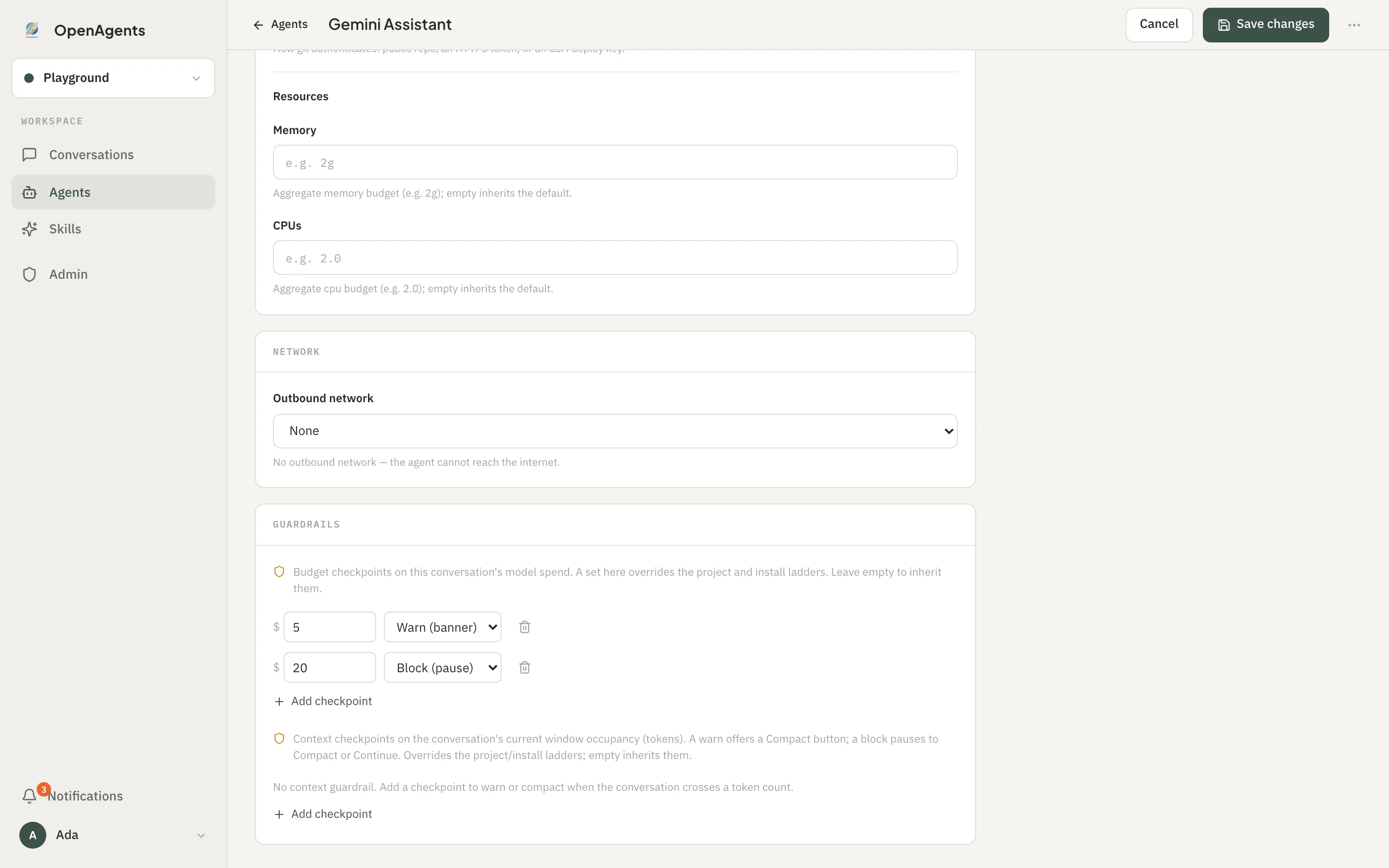
OpenAgents is our pick for teams whose evaluation is driven by isolation and network governance. It is a chat interface where a team of specialized agents collaborates, and each agent runs in its own per-conversation virtualized sandbox. Network egress allowlists, per-project secrets, and spend guardrails are enforced by the platform, and role-based project admin controls who can change them. It is provider-flexible, including local models, with your own keys and anytime switching. It stays usable for non-technical teammates, and it is capable enough for agents to build and run software with a live preview — going beyond answering over your documents.
Best for: security-conscious organizations that want per-agent isolation and network governance, and teams that want agents to build software. See the AI agent platform for companies pillar and the running AI agents securely use case.
2. CrewAI — best if engineers want to build in code
If your users are engineers who want to express agent logic directly in code and own the runtime, a code-first framework like CrewAI is a legitimate alternative, and its CrewAI AOP control plane adds a visual builder and governance on top. You trade a hosted, connector-driven workspace for code-level control. See CrewAI alternatives and OpenAgents vs CrewAI for the trade-offs.
3. Lindy — best for a fast no-code start
Lindy is a no-code visual agent builder that is quick to stand up. It suits teams that want to ship simple automations fast and are comfortable with a fully hosted SaaS product, without a hard requirement for per-agent isolation or self-hosting.
4. Other options to know
Depending on your stack, you may also evaluate connector-heavy or platform-native assistants tied to your existing cloud or productivity suite. These can be convenient if you are standardizing on one vendor, but they typically offer less isolation and network governance. Verify each against your requirements before shortlisting.
How to choose
- Need per-agent isolation and network governance, or agents that build software → OpenAgents.
- Your users are engineers who want code-level control → CrewAI (with AOP for a UI and governance).
- You want the fastest no-code start and are fine with hosted-only → Lindy.
- You are standardizing on one cloud or suite and value convenience → a platform-native assistant.
Most teams that came looking for a Dust alternative because of isolation or network governance end up shortlisting OpenAgents. Try it with your own providers and governance settings — Get started.
Dust alternatives: common questions
What is the best Dust alternative for security-conscious teams?
For teams whose priority is isolation and network governance, OpenAgents is the strongest fit: each agent runs in its own per-conversation sandbox, and network egress allowlists, per-project secrets, and spend guardrails are enforced by the platform.
Which Dust alternative can agents use to build and run software?
OpenAgents. Its agents write, run, and show a live preview inside the sandbox, which a connected-knowledge workspace is not designed to do.
Which Dust alternative is best for engineers who prefer code?
A code-first framework such as CrewAI, optionally with its AOP control plane. You trade the hosted, connector-driven workspace for full control in code.
Is there a Dust alternative I can self-host?
Self-hosting is one area where Dust itself is strong — its open-source core is available under the MIT license. If self-hosting is your hard requirement, weigh that against the isolation and network-governance reasons teams move to a sandboxed platform, and confirm each option's current deployment model before you decide.
How is OpenAgents different from a connected-knowledge workspace?
A workspace like Dust is built to answer over your company's data through connectors. OpenAgents is built to run agents safely and let them do work: each agent is sandboxed, its network access is allowlisted, and it can build and run software with a live preview. Different jobs — pick by which one you need.
Do these alternatives include real product screenshots and dated comparisons?
Yes. This guide references real product screens, dates its claims (July 2026), and avoids invented numbers.