CrewAI Alternatives
CrewAI is a popular code-first framework for building multi-agent systems, and it now pairs that framework with CrewAI AOP, an enterprise control plane that adds a visual builder and governance. For engineering teams that want to work in code, it is a strong choice. But not every team wants to define agents in code or assemble their own execution sandbox — and some need per-agent isolation and network governance built into the platform. This guide ranks the best CrewAI alternatives as of July 2026, honestly, with no invented benchmarks and dated claims.
For the direct head-to-head, read OpenAgents vs CrewAI.
What to look for in a CrewAI alternative
Teams look past a code-first framework when the cost of building and running the runtime outweighs the control it gives them. The usual triggers: you want per-agent isolation built in rather than wiring a dedicated sandbox service (CrewAI deprecated its built-in code execution and now recommends E2B or Modal); you want network egress allowlists as a platform control; or you want a chat surface non-technical teammates already use without building around a framework. Rank alternatives against whichever of these made you look — and note that CrewAI AOP already covers a visual builder, role-based access, audit logs, approvals, and cost dashboards, so "no UI" or "no governance" is not the reason to switch. The reason is where isolation and egress governance live.
How we ranked these CrewAI alternatives
This list is ordered by fit for the team that likes the multi-agent idea but wants isolation and egress governance as platform defaults rather than pieces it assembles. That is not a knock on CrewAI — for engineers who want code-level control and are happy to adopt AOP and attach a sandbox service, a framework is the right tool, and this guide says so. Where a different need dominates, such as connected-knowledge assistants, it points you to the better fit. Nothing here relies on invented benchmarks, and claims are dated July 2026 because these tools change quickly.
1. OpenAgents — best for built-in isolation and egress governance
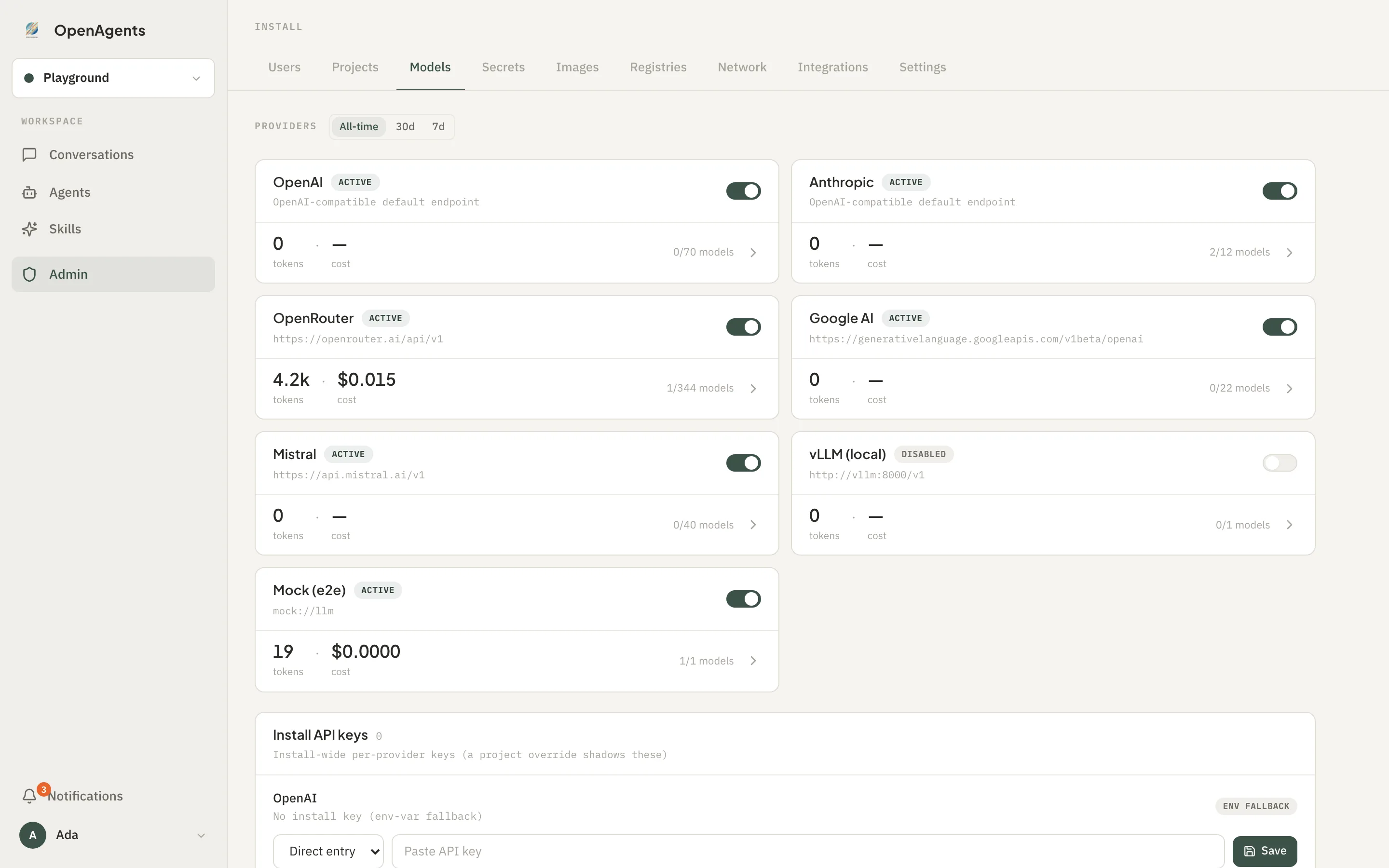
OpenAgents is our pick for teams that want per-agent isolation and network governance without assembling a runtime. It is a chat interface where a team of specialized agents collaborates, and each agent runs in its own per-conversation virtualized sandbox by default. Where CrewAI, having deprecated its built-in code execution, directs you to a separate sandbox service such as E2B or Modal, OpenAgents ships isolation as a platform primitive. Governance is platform-enforced too: network egress allowlists, per-project secrets, spend guardrails, and role-based project admin. It is provider-flexible — route each agent to OpenAI, Anthropic, Google, OpenRouter, or a local model with your own keys and switch anytime — and its skills and agents are versioned, editable, and reusable across projects. Non-technical teammates use the same agents your engineers configure, and agents can build and run software with a live preview.
Best for: teams that want isolation, egress governance, and a usable chat surface as defaults. See the AI agent platform for companies pillar and building software with AI agents.
2. CrewAI AOP — best if you want to stay in the CrewAI ecosystem
If you already build with CrewAI's framework, CrewAI AOP is the natural way to add a visual builder, governance, and observability without leaving the ecosystem. You keep code-level control and gain role-based access, audit logs, approvals, SSO, and cost dashboards. The trade-off versus a sandboxed platform is that per-agent OS-level isolation and network egress allowlists are not built-in primitives — you add a dedicated sandbox service for code execution and handle egress yourself.
3. A hosted agent workspace (for example, Dust) — best for connected-knowledge assistants
If your goal is broad assistants grounded in company data rather than multi-agent orchestration in code, a hosted enterprise workspace such as Dust may fit better. It trades code-level control for a fast, connector-driven setup and is model-agnostic across major providers. See Dust alternatives for that side of the market.
4. Other multi-agent frameworks — best if you are committed to code
If you like the code-first model and are simply comparing frameworks, there are other libraries in the same category to evaluate on ergonomics, community, and how they fit your stack. They keep the trade-off CrewAI makes at the framework layer: full control, but you own the UI, isolation, and governance unless you adopt a platform on top.
How to choose
- Want built-in per-agent isolation and egress governance without assembling a runtime → OpenAgents.
- Want to stay in the CrewAI ecosystem and add a UI, governance, and observability → CrewAI AOP.
- Want connected-knowledge assistants over company data → a hosted workspace like Dust.
- Committed to code-first control and just comparing libraries → another multi-agent framework.
If you started with CrewAI but want isolation and network governance as platform defaults rather than services you wire together, OpenAgents gives you those out of the box. Try it with your own providers — Get started.
CrewAI alternatives: common questions
What is the best CrewAI alternative with built-in sandboxing?
OpenAgents. Each agent runs in its own per-conversation sandbox by default, so you do not attach an external execution service to isolate agent code.
Which CrewAI alternative enforces network egress controls?
OpenAgents enforces network egress allowlists, per-project secrets, spend guardrails, and role-based project admin at the platform level.
Does CrewAI already have a UI and governance?
Yes — CrewAI AOP adds a visual builder, role-based access, audit logs, approvals, SSO, and dashboards. The reason to consider an alternative is usually built-in isolation and egress governance, not the absence of a UI.
Do I lose provider flexibility by moving off a framework?
No. OpenAgents routes each agent to OpenAI, Anthropic, Google, OpenRouter, or a local model with your own keys, switchable anytime.