OpenAgents vs CrewAI
CrewAI and OpenAgents both let a team of agents collaborate, but they start from different places. CrewAI began as a code-first, open-source multi-agent framework and now also offers CrewAI AOP (its Agent Operations Platform), an enterprise control plane with a visual builder and governance. OpenAgents is a product from the start — a chat where a team of specialized agents works, each running in its own per-conversation virtualized sandbox, with network egress allowlists, secrets, and spend guardrails enforced by the platform. The short verdict, as of July 2026: choose CrewAI when engineers want to define agent logic in code and assemble the runtime, and choose OpenAgents when you want built-in per-agent isolation and egress governance in a chat your whole team already uses.
This page compares the two fairly, uses no invented benchmarks, and dates its claims because both products change quickly.
At a glance
| Capability | OpenAgents | CrewAI |
|---|---|---|
| Product model | Hosted, ready-to-use chat platform | Open-source framework, plus CrewAI AOP as an enterprise control plane |
| Isolation / sandboxing | Every agent runs in its own per-conversation virtualized sandbox, built in | Built-in code execution was deprecated and removed; CrewAI recommends a dedicated external sandbox service such as E2B or Modal |
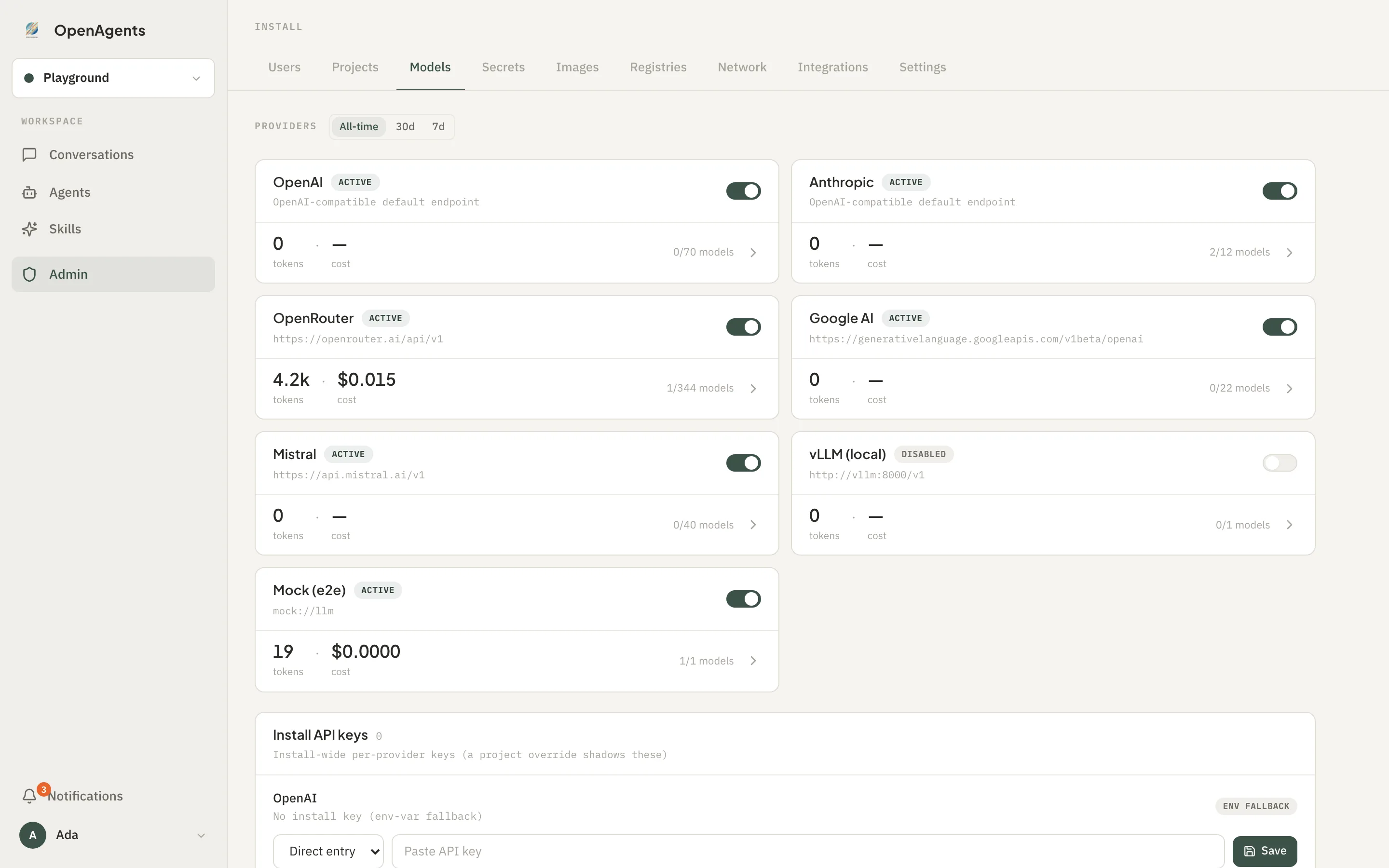
| Provider flexibility | Route each agent to OpenAI, Anthropic, Google, OpenRouter, or a local model; switch anytime; bring your own keys | Broad model/provider support in code; you wire and manage keys yourself |
| Governance (egress / secrets / spend) | Network egress allowlists, per-project secrets, spend guardrails, role-based project admin — platform-enforced | AOP adds role-based access, audit logs, human-in-the-loop approvals, SSO, and cost/latency dashboards; network egress allowlists are not a documented primitive |
| No-code usability | Chat interface for non-technical and technical users | Code-first at the core; AOP adds a visual low-code builder for technical and non-technical users |
| Builds & runs software | Agents write, run, and show a live preview inside the sandbox | You build agents that run code, but you supply the execution sandbox (for example, E2B or Modal) |
| Best-fit team | Teams wanting built-in isolation and egress governance without assembling a runtime | Engineering teams that want code-level control and are comfortable operating or adopting AOP |
Comparison compiled July 2026 from CrewAI's public documentation and product pages. CrewAI is actively developed; re-check any row before relying on it.
Where CrewAI shines
CrewAI is a strong fit for engineering teams that want to express multi-agent logic directly in code and keep full control of the design. Its open-source framework is widely adopted, has a large community, and lets you define agents, tasks, and tools in Python or YAML and version them like any other software. For teams that want to operate at scale, CrewAI AOP adds a centralized control plane: a visual low-code builder that technical and non-technical users can work in, plus role-based access, audit logs, human-in-the-loop approvals, single sign-on, and real-time dashboards for latency and estimated cost. If you want code-level control, or a framework you can embed inside a larger system and grow into an enterprise platform, CrewAI is a credible, capable choice.
Where OpenAgents shines
OpenAgents is the better fit when isolation and egress governance should be built into the platform rather than assembled around it.
- Per-agent isolation, built in. Each agent runs in its own per-conversation virtualized sandbox by default. You do not stand up or maintain a separate execution service — where CrewAI, having deprecated its built-in code execution, points you to E2B or Modal, OpenAgents ships isolation as a platform primitive.
- Network egress allowlists as a control. OpenAgents lets you allowlist where an agent can reach on the network, alongside per-project secrets and spend guardrails, all enforced by the platform and governed by role-based project admin.
- One surface for build, run, and preview. Agents write, run, and show a live preview inside the sandbox, in the same chat your team uses — there is no separate front end or runtime to wire together.
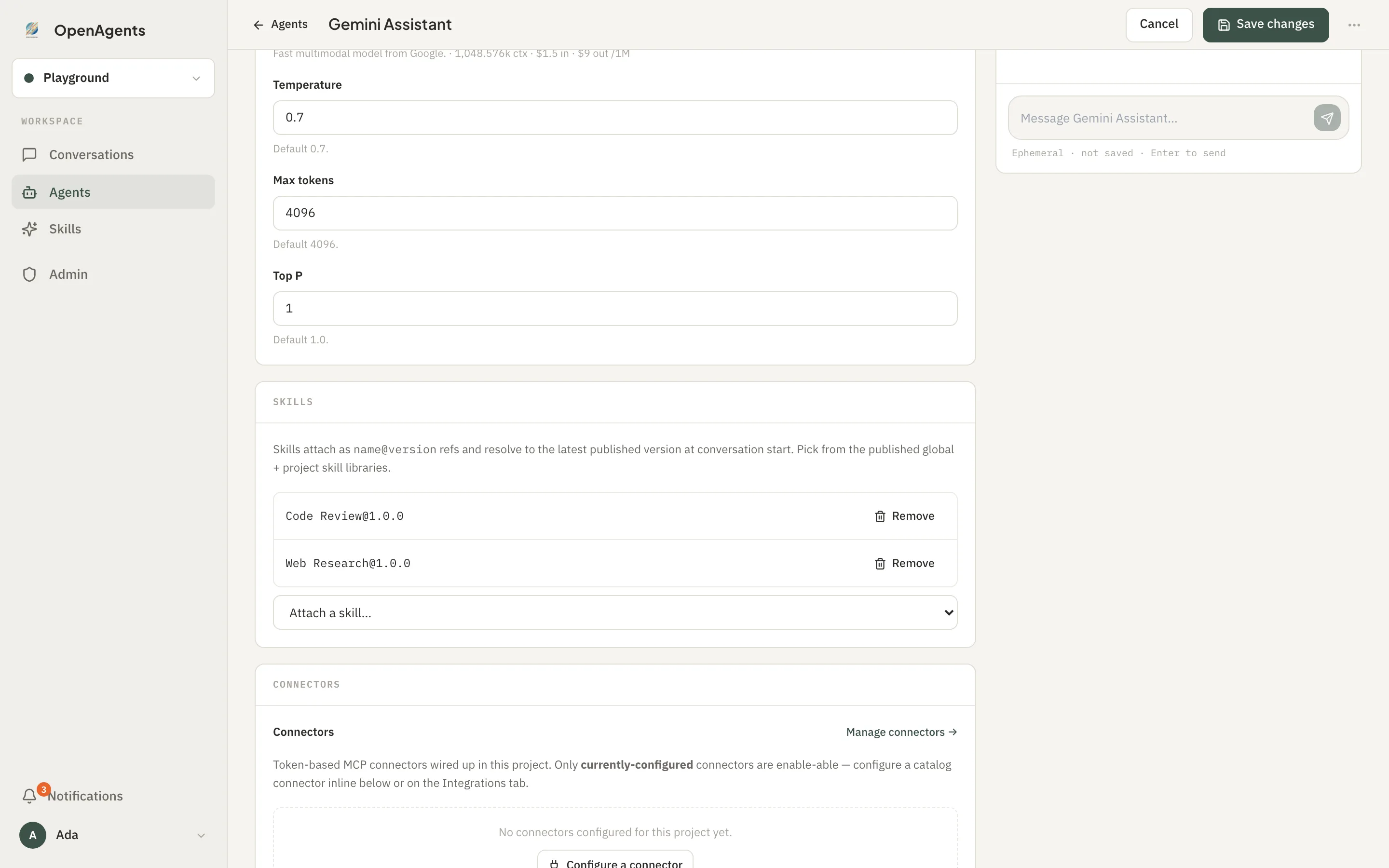
- Provider choice, centrally owned. Switch any agent between OpenAI, Anthropic, Google, OpenRouter, or a local model with your own keys, and let a software org own reusable, versioned skills and agents across projects.
Which should you choose?
- Choose CrewAI if your users are engineers who want agent behavior defined in code, you want to own the runtime (including wiring an external sandbox service for code execution), or you want its AOP control plane and are comfortable adopting it.
- Choose OpenAgents if you want built-in per-agent sandbox isolation and network egress governance out of the box, a chat non-technical teammates already use, and agents that build and run software with a live preview — without assembling an execution service.
Both can be right depending on where your team wants to spend its effort: CrewAI gives you control in code and a platform to grow into; OpenAgents gives you isolation and governance as defaults. If you build products with agents, see building software with AI agents. For the full overview, read the AI agent platform for companies pillar. Comparing against a hosted workspace instead? See OpenAgents vs Dust, or browse all OpenAgents comparisons (an autonomous-coding comparison, versus Devin, is on the way). Weighing the category broadly? Read our CrewAI alternatives guide.
Want isolation and governance as platform defaults, in a UI your whole team uses? Get started.
OpenAgents vs CrewAI: common questions
Is OpenAgents a framework like CrewAI?
No. CrewAI's core is a code-first framework you build on and run yourself, now paired with its AOP control plane. OpenAgents is a ready-to-use platform: the chat UI, per-agent sandboxing, and egress governance are built in, so there is no runtime or separate sandbox service for you to assemble.
Does CrewAI have a UI now?
Yes. CrewAI AOP adds a visual low-code builder that technical and non-technical users can work in, along with governance and observability. The difference is not "UI versus no UI" — it is where isolation and network governance live. OpenAgents makes per-conversation sandboxing and egress allowlists platform defaults; with CrewAI you add a dedicated sandbox service for code execution.
Can OpenAgents run code and build software the way CrewAI agents can?
Yes, and it runs that code inside each agent's own sandbox with a live preview — you do not attach an external execution service to get there.
Can I still switch model providers freely?
Yes. Route each agent to OpenAI, Anthropic, Google, OpenRouter, or a local model with your own keys, and switch anytime. Skills and agents are versioned and reusable across projects.
How current is this comparison?
It reflects CrewAI's public documentation and product pages as of July 2026. CrewAI ships often, so re-verify before you decide.