OpenAgents vs Dust
Both OpenAgents and Dust give a company a place where AI agents work alongside a team, and they aim at different centers of gravity. Dust is a multiplayer enterprise agent workspace built to ground assistants in your company's data through 100+ connectors, with an open-source core and a hosted commercial product. OpenAgents is a governed, sandboxed chat where a team of agents works, each running in its own per-conversation virtualized sandbox, with network egress allowlists, secrets, and spend guardrails enforced by the platform. The short verdict, as of July 2026: pick Dust if your priority is assistants grounded in connected company knowledge; pick OpenAgents if per-agent isolation and network/spend governance are requirements.
This page compares the two on the dimensions buyers evaluate. It uses no invented benchmarks and dates its claims because both products change quickly.
At a glance
| Capability | OpenAgents | Dust |
|---|---|---|
| Isolation / sandboxing | Every agent runs in its own per-conversation virtualized sandbox | Hosted multiplayer workspace; per-conversation OS-level sandboxing is not a documented, user-facing control |
| Provider flexibility (BYO model) | Route each agent to OpenAI, Anthropic, Google, OpenRouter, or a local model; switch anytime; bring your own keys | Model-agnostic across major providers (OpenAI, Anthropic, Google, Mistral, xAI) with a zero-data-retention policy; local-model and per-agent key handling are less of a focus |
| Governance (egress / secrets / spend) | Network egress allowlists, per-project secrets, spend guardrails, role-based project admin — platform-enforced | Enterprise controls (SSO, SCIM, RBAC, SOC 2 / GDPR / HIPAA-ready, EU residency) and connector permissions; network egress allowlists and per-agent spend caps are not documented primitives |
| Connected company knowledge | Not the core focus | A core strength — 100+ connectors, MCP, REST API, webhooks |
| Builds & runs software | Agents write, run, and show a live preview inside the sandbox | Positioned around knowledge assistants over company data, not building and running software |
| Self-hostable | Managed platform; a self-managed deployment is not confirmed in the product spec | Open-source core (MIT) can be self-hosted; the commercial product is hosted SaaS |
| Best-fit team | Security-conscious orgs that want per-agent isolation, egress/spend governance, and to build software | Teams standardizing on assistants grounded in many internal data sources |
Comparison compiled July 2026 from Dust's public documentation and product pages. Re-verify before relying on any row.
Where Dust shines
Dust is strong when the job is to put helpful assistants in front of a whole company and ground them in internal knowledge. Its 100+ connectors and hosted workspace make it quick to point agents at documents, tickets, and chat history so employees can ask questions in plain language, and it is model-agnostic across the major providers with a zero-data-retention policy. For enterprises, it brings SSO, SCIM, role-based access, EU data residency, and SOC 2 / GDPR / HIPAA-ready compliance, and its open-source core means self-hosting is a documented option. If connected-knowledge assistants are your priority, Dust is a well-fit, capable choice.
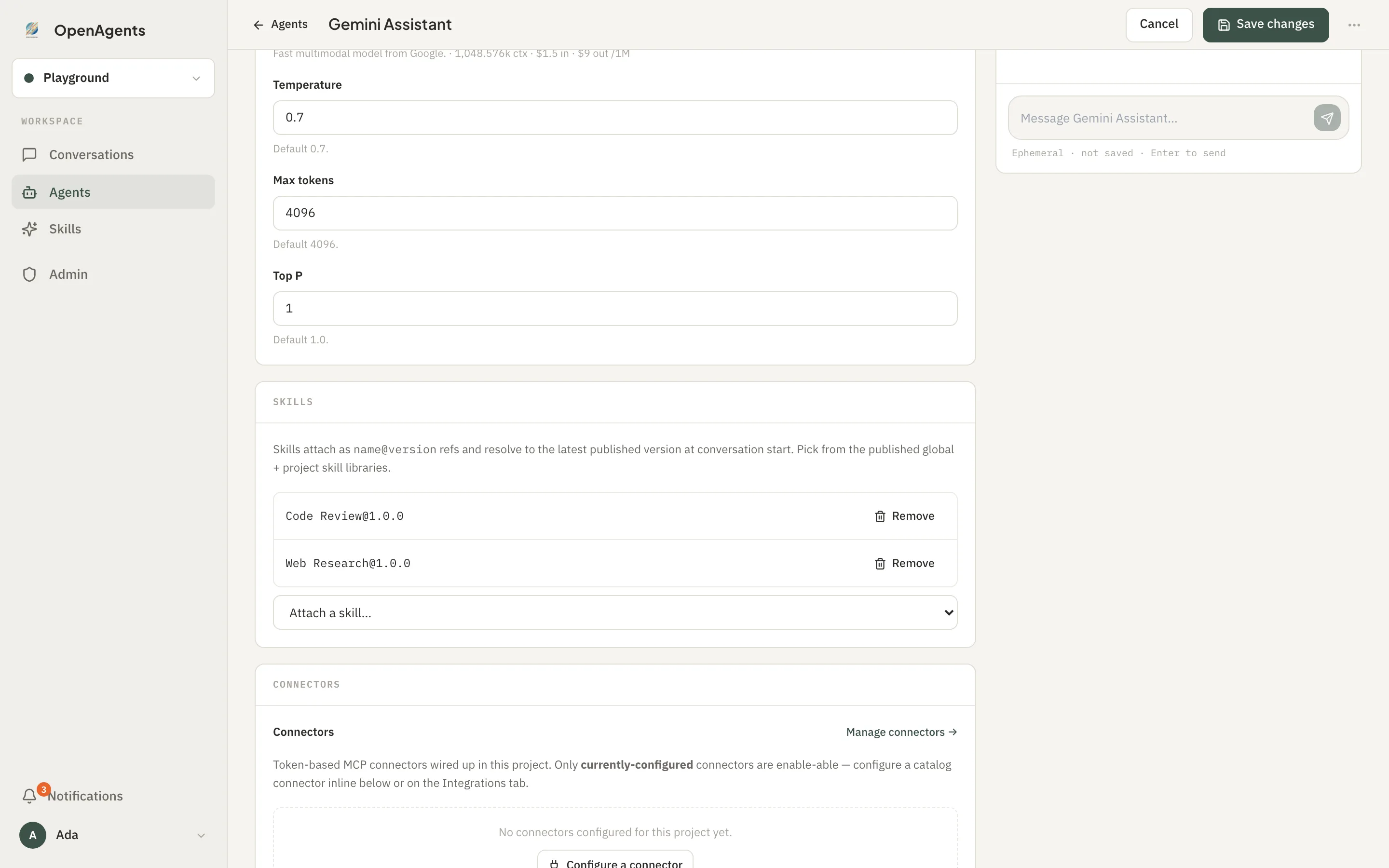
Where OpenAgents shines
OpenAgents leads when isolation and network governance are requirements, not nice-to-haves.
- Isolated by default. Each agent runs in its own per-conversation virtualized sandbox, so one conversation's work is contained and cannot reach into another's environment.
- Network egress allowlists and spend guardrails. OpenAgents lets you allowlist where an agent can reach on the network and cap spend, alongside per-project secrets — controls the platform enforces, governed by role-based project admin. These are primitives, not conventions you hope agents follow.
- Provider choice down to local models. Route each agent to OpenAI, Anthropic, Google, OpenRouter, or a local model, bring your own keys, and switch anytime — useful when a model must stay in your own environment.
- Builds and runs real software. Agents write, run, and show a live preview inside the sandbox, so a prompt can become a working, clickable result — not just an answer over your documents.
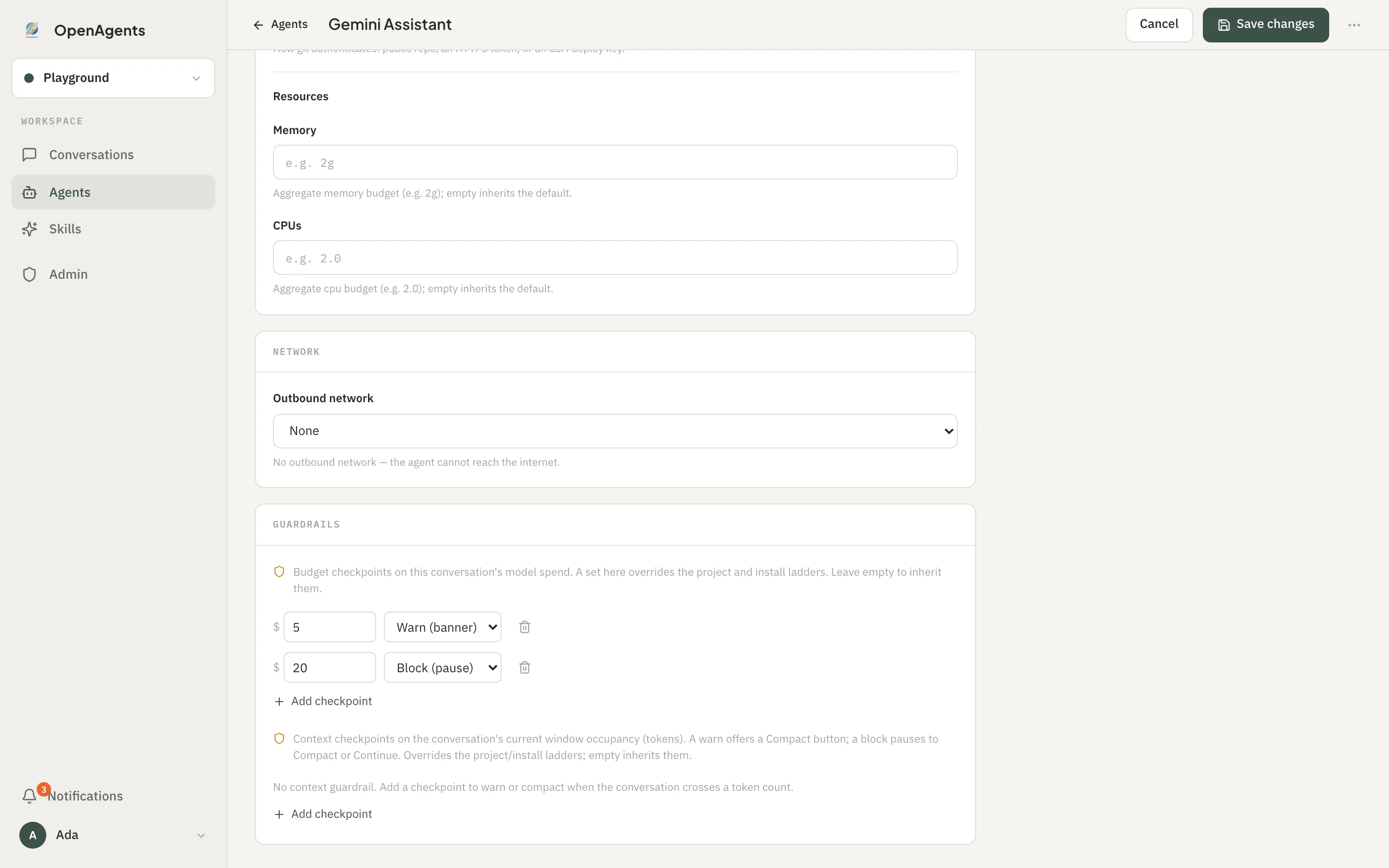
Which should you choose?
- Choose Dust if your main goal is assistants grounded in connected internal data, you value its connector breadth and enterprise compliance, and per-conversation sandboxing or network egress allowlists are not central to your security review.
- Choose OpenAgents if a security or platform team will review the deployment, you need per-agent isolation with network-egress and spend governance, you want to route agents to local models, or you want agents that build and run software with a live preview.
Many teams evaluate both alongside a code-first framework. If your audience is mostly engineers, compare OpenAgents vs CrewAI, or browse all OpenAgents comparisons to weigh the category more broadly (a no-code-builder comparison, versus Lindy, is on the way). For the honest overview of what OpenAgents is, read the AI agent platform for companies pillar, and for the isolation story in depth, see running AI agents securely. Still shopping the category? See our take on Dust alternatives.
Ready to try it with your own providers and governance settings? Get started.
OpenAgents vs Dust: common questions
Is OpenAgents a drop-in replacement for Dust?
Not exactly — the two target different jobs. Dust centers on assistants connected to company knowledge; OpenAgents centers on isolated, governed agents that can also build and run software. Decide by your top requirement, not by feature count.
Does every agent really get its own sandbox?
Yes. In OpenAgents each agent runs in its own per-conversation virtualized sandbox. Dust is a hosted workspace and does not document per-conversation OS-level sandboxing as a user-facing control.
Do both let me choose my model provider?
Yes. Dust is model-agnostic across major providers, and OpenAgents routes each agent to OpenAI, Anthropic, Google, OpenRouter, or a local model with your own keys, switchable anytime — the local-model option is the main difference.
Which one can I self-host?
Dust has an open-source core (MIT) that can be self-hosted, with a hosted commercial product alongside it. OpenAgents is offered as a managed platform; confirm current deployment options with the team if self-hosting is a requirement.
How current is this comparison?
It reflects public information as of July 2026. Both products move quickly, so re-check anything that matters to your decision.